

FancyMancy
Well-known member
This article includes pictures which I have excluded here.
10 June 2026
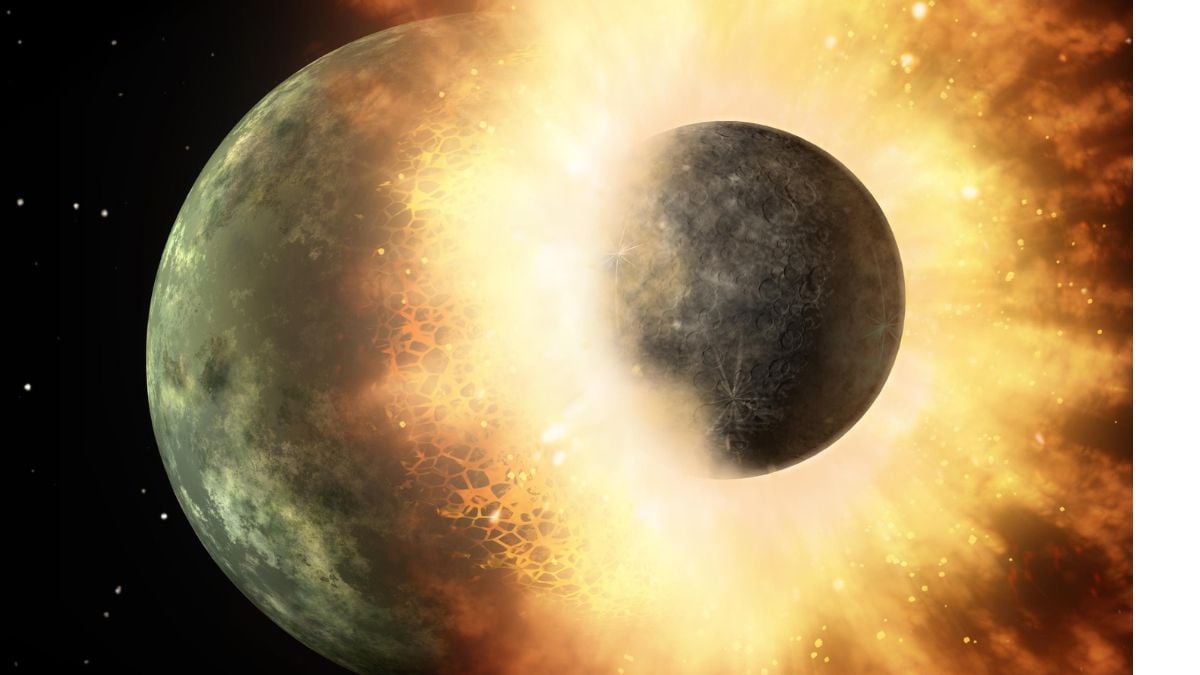
Our Solar System may once have housed an extra world that no longer exists.
This long-lost world may have been almost as big as Mars, before it suffered a cataclysmic end.
And we might never have known about it, if pieces of it hadn't ended up right here on Earth.
Around 4.56 billion years ago, our fledgling Solar System resembled a demolition derby of explosively colliding rocks and untold planetary bodies.
Now, a recent study has offered additional evidence that our solar menagerie included an additional Moon-to-Mars-sized "planetary embryo."
"It's incredible to think there was once a world this large," says Aaron Bell, an experimental petrologist at the University of Colorado Boulder and the study's first author.
"We only know it existed because a few fragments of it happened to land on Earth."
Indeed, the latest evidence for the size of this potentially first-generation protoplanet comes from something much smaller: a meteorite weighing only about half a kilogram (1 pound).
The NWA (Northwest Africa) 12774 meteorite was discovered in 2019 in the Sahara Desert. It's composed of a dark matrix studded with small crystals of olivine, an incredibly common mineral group and a primary constituent of Earth's mantle.
NWA 12774 belongs to an exceptionally rare group of stony meteorites called angrites, which constitute just 0.09 percent of the meteorites discovered on Earth.
Angrites are also exceedingly ancient. They are the oldest known igneous rocks, formed only a few million years after the first solids coalesced from our solar nebula, back when the Universe was just two-thirds of its current age.
Meteorites in this group are thought to have originated from the fragmentation of a larger object, which scientists dub the angrite parent body (APB). But the size of this body is hotly debated.
Since angrites hold only tiny amounts of silicon dioxide (silica), a major component of the rocky planets, some have surmised that the APB may have been an asteroid with a radius of up to 200 kilometers (124 miles), that formed further away from the Sun.
It may have been similar to Vesta, the second-largest object in our main asteroid belt that forms the rocky-to-gassy delineation between inner planet Mars and outer gas giant Jupiter.
"The materials that formed the angrite parent body are fundamentally different from the ingredients of Earth and Mars," explains Bell.
"It points to a distinct and separate evolutionary path in planetary formation in the early history of our Solar System."
Other researchers have suggested that the APB may have been a planet-sized world, based on meteoritic evidence of its interior magmatic activity.
So, to further constrain the size of this puzzling protoplanetary body, a trio of earth scientists and geochemists examined NWA 12774 in more delicate detail.
They assessed its crystal assemblages and composition using electron microprobe analysis and high-resolution X-ray maps.
They also developed a novel geobarometric model to reconstruct the amount of pressure required to form the features seen in NWA 12774.
The researchers found that NWA 12774 contains especially aluminum-rich clinopyroxene crystals, which form under high-pressure conditions.
The innards of a smaller, asteroidal object may not be powerful enough. That hints that the meteorite originated in the high-pressure, magmatic interior of an immense, planetary body.
Based on geobarometric calculations, estimated core mass, and estimated mantle density, among other factors, the researchers calculated that the APB's minimum radius may have been around 1,000 kilometers.
However, the relatively pristine nature of its constituent crystals, which preserved their chemical patterns and jagged edges, suggests a relatively shallow origin in a large magma reservoir – and thereby a much larger size estimate.
As a result, the bygone APB may have had a radius of 1,800 kilometers, making it slightly wider than the Moon (1,740 kilometers). Upper-range estimates suggest the APB may have been even bigger, around 3,300 kilometers in radius, or a bit smaller than Mars (3,390 kilometers).
It's unknown how this incipient potential planet met its untimely doom. According to unrelated research, it may even be hypothetically possible that a young, rampaging Jupiter helped seal its demise.
But whether it was shattered by a cataclysmic collision or shredded by gravitational interactions, its splinters sprinkled the Solar System, providing a plucky species of primates on a surviving, living planet with the chance to decipher its remote, fleeting existence.
It's not unreasonable to think (and hope) that the ghosts of other protoplanets may be discovered, based on the meteoritic material still hidden in the Solar System, locked away in the dark, dusty confines of… Earth's various receptacles.
"There are many meteorites sitting in drawers that haven't been thoroughly studied, so there were likely more of these protoplanets we don't know about," says Bell.
This research was published in Earth and Planetary Science Letters.
 www.sciencealert.com
According to an AI chatbot where I asked "Where in the Solar System?", it said -
The article doesn't specify where in the Solar System this lost world orbited.
However, the article does mention that some scientists have theorised the angrite parent body may have formed further away from the Sun, and may have been similar to Vesta, the second-largest object in the main asteroid belt between Mars and Jupiter. (Science Alert) The article also notes that "the materials that formed the angrite parent body are fundamentally different from the ingredients of Earth and Mars," pointing to a distinct evolutionary path in the early Solar System. (Science Alert)
So whilst the exact orbital location isn't stated, the evidence suggests it likely occupied a region distant from the inner terrestrial planets, possibly somewhere in or beyond the asteroid belt region, but the article doesn't provide a definitive answer on this point.
10 June 2026
Our Solar System may once have housed an extra world that no longer exists.
This long-lost world may have been almost as big as Mars, before it suffered a cataclysmic end.
And we might never have known about it, if pieces of it hadn't ended up right here on Earth.
Around 4.56 billion years ago, our fledgling Solar System resembled a demolition derby of explosively colliding rocks and untold planetary bodies.
Now, a recent study has offered additional evidence that our solar menagerie included an additional Moon-to-Mars-sized "planetary embryo."
"It's incredible to think there was once a world this large," says Aaron Bell, an experimental petrologist at the University of Colorado Boulder and the study's first author.
"We only know it existed because a few fragments of it happened to land on Earth."
Indeed, the latest evidence for the size of this potentially first-generation protoplanet comes from something much smaller: a meteorite weighing only about half a kilogram (1 pound).
The NWA (Northwest Africa) 12774 meteorite was discovered in 2019 in the Sahara Desert. It's composed of a dark matrix studded with small crystals of olivine, an incredibly common mineral group and a primary constituent of Earth's mantle.
NWA 12774 belongs to an exceptionally rare group of stony meteorites called angrites, which constitute just 0.09 percent of the meteorites discovered on Earth.
Angrites are also exceedingly ancient. They are the oldest known igneous rocks, formed only a few million years after the first solids coalesced from our solar nebula, back when the Universe was just two-thirds of its current age.
Meteorites in this group are thought to have originated from the fragmentation of a larger object, which scientists dub the angrite parent body (APB). But the size of this body is hotly debated.
Since angrites hold only tiny amounts of silicon dioxide (silica), a major component of the rocky planets, some have surmised that the APB may have been an asteroid with a radius of up to 200 kilometers (124 miles), that formed further away from the Sun.
It may have been similar to Vesta, the second-largest object in our main asteroid belt that forms the rocky-to-gassy delineation between inner planet Mars and outer gas giant Jupiter.
"The materials that formed the angrite parent body are fundamentally different from the ingredients of Earth and Mars," explains Bell.
"It points to a distinct and separate evolutionary path in planetary formation in the early history of our Solar System."
Other researchers have suggested that the APB may have been a planet-sized world, based on meteoritic evidence of its interior magmatic activity.
So, to further constrain the size of this puzzling protoplanetary body, a trio of earth scientists and geochemists examined NWA 12774 in more delicate detail.
They assessed its crystal assemblages and composition using electron microprobe analysis and high-resolution X-ray maps.
They also developed a novel geobarometric model to reconstruct the amount of pressure required to form the features seen in NWA 12774.
The researchers found that NWA 12774 contains especially aluminum-rich clinopyroxene crystals, which form under high-pressure conditions.
The innards of a smaller, asteroidal object may not be powerful enough. That hints that the meteorite originated in the high-pressure, magmatic interior of an immense, planetary body.
Based on geobarometric calculations, estimated core mass, and estimated mantle density, among other factors, the researchers calculated that the APB's minimum radius may have been around 1,000 kilometers.
However, the relatively pristine nature of its constituent crystals, which preserved their chemical patterns and jagged edges, suggests a relatively shallow origin in a large magma reservoir – and thereby a much larger size estimate.
As a result, the bygone APB may have had a radius of 1,800 kilometers, making it slightly wider than the Moon (1,740 kilometers). Upper-range estimates suggest the APB may have been even bigger, around 3,300 kilometers in radius, or a bit smaller than Mars (3,390 kilometers).
It's unknown how this incipient potential planet met its untimely doom. According to unrelated research, it may even be hypothetically possible that a young, rampaging Jupiter helped seal its demise.
But whether it was shattered by a cataclysmic collision or shredded by gravitational interactions, its splinters sprinkled the Solar System, providing a plucky species of primates on a surviving, living planet with the chance to decipher its remote, fleeting existence.
It's not unreasonable to think (and hope) that the ghosts of other protoplanets may be discovered, based on the meteoritic material still hidden in the Solar System, locked away in the dark, dusty confines of… Earth's various receptacles.
"There are many meteorites sitting in drawers that haven't been thoroughly studied, so there were likely more of these protoplanets we don't know about," says Bell.
This research was published in Earth and Planetary Science Letters.
A Lost World Almost as Big as Mars May Have Once Orbited Our Sun
Our Solar System may once have housed an extra world that no longer exists.
www.sciencealert.com
According to an AI chatbot where I asked "Where in the Solar System?", it said -
The article doesn't specify where in the Solar System this lost world orbited.
However, the article does mention that some scientists have theorised the angrite parent body may have formed further away from the Sun, and may have been similar to Vesta, the second-largest object in the main asteroid belt between Mars and Jupiter. (Science Alert) The article also notes that "the materials that formed the angrite parent body are fundamentally different from the ingredients of Earth and Mars," pointing to a distinct evolutionary path in the early Solar System. (Science Alert)
So whilst the exact orbital location isn't stated, the evidence suggests it likely occupied a region distant from the inner terrestrial planets, possibly somewhere in or beyond the asteroid belt region, but the article doesn't provide a definitive answer on this point.


