Renenutet was integrated in every aspect of Egyptian civil life as the great goddess of sustenance and abundance, civilization, granaries, vineyards, judgement, fate and personal defense of the Pharaoh and the Egyptian realm. ¹ The Egyptian people adored her as a savior of agriculture and viniculture², in inaugurating the great harvest season of the vast empire., and for good reason, as she represented the abundance of the great yield being given resplendently to the needy, so celebrations to her were a common feature of life in Egypt. Just as much, however, she could represent a terrifying punitive aspect of leaving the land without life. Many of her later sets of symbolism are arcane and relate to the nourishment of the soul. The serpent goddess is the syncretistic combination of the Nebty, the two lady goddesses Wadjet and Nekhbet, who represented Lower and Upper Egypt respectively.
Stela with the Representation of Nekhbet-Renenutet – Museum of Fine Arts, Budapest
Her role in mythology is distinct. From the ancient Pyramid Texts and as one of Egypt's oldest deities, she is considered to be the guardian of the Pharaoh, at least linguistically in function. The Utterances allude to her as the personification of the Renenutet garment, ³ the eye of Horus, which Egyptologists consider to be a particularly important vestige of royal symbolism in Egypt. By presenting the pharaoh with the divine attire, it is interpreted that she gave majesty with a form of prosperity that commands respect from the divine, not merely the mortal world. The eye also changes the fate of the Pharaoh. Elsewhere in the most ancient texts, her earliest secure textual footing is in the Old Kingdom funerary corpus where she appears as an aspect of the fiery uraeus, showing off her royal protection.
Utterance 256, Pyramid Texts ⁴
the flame of the blast of his effective uraeus is Renenutet on his head.
Utterance 622, Recitation of Pepi II Neferkare, Tending the Spirit as Osiris, Pyramid Texts ³
Osiris Pepi Neferkare, I have arrayed you with Horus’s eye, this Renenutet of whom the gods have been fearful, that the gods may be fearful of you like they are fearful of Horus’s eye.
Renenutet is also described vaguely as having tools that nourish the
ka (vital essence) of the Pharaoh, like her oil of jubilation.⁵ From a young age, the Pharaoh could count on her nourishment and support as a deity who protected him and the royal house. However, her role of judgement in this regard also applied to the Weighing Ceremony, on the basis that she who creates and nourishes can also take. To invoke her was not a joking matter. From the Middle Kingdom onwards, her links to ultimate fate become more apparent. The Coffin Texts⁶ equate her with being the god of fate Nehekbau's mother, and the Rifeh coffin inscriptions among these name her as the 'revered one. ' The New Kingdom Papyrus of Ani ⁷ shows her at the side of Shai and Meshkenet, being part of the divine contingent of the Weighing of the Heart. Variations of the Book of the Dead increasingly link her into that ceremony too.
The multidimensionality of her cult appeared to expand and become more marked during the New Kingdom era. ⁹ Major representations of Renenutet as a motherly goddess proliferate at that point of Egyptian history, which is related to her name meaning and cult title, She Who Rears. Increasingly, she became associated with her son, Nepri, the grain god, who makes up a majority of the scenes of her nursing children. She became associated with
the ren or secret name given to the child,¹⁰ while bowls fashioned in the form of cobras were used for juveniles needing milk,¹¹ possibly for protective purposes. The amount of hymns about her specifically proliferate after the New Kingdom, or at least these are the extant examples of a much older corpus. Her hymnal repertoire indicates a particular need for the Egyptians for relief and centers the harvest season as most important.;¹² Elite women often tended to her cult publicly, which is evidenced in the amount of depictions of Great Royal Wives in adjacency to the cobra goddess in Egyptian sacred art. ¹³ Other evolutions of her cult existed in the New Kingdom corpus, such as the papyrus showing her delivering boxes of treasure to the sea and then sends a messenger bird to the Canaanite goddess Astarte.¹⁴ The depictions of the goddess in Theban tombs show her presiding over fieldmen in vineyards picking grapes and delivering them to her.¹⁵ On the early stela of Setau,¹⁶ the viceroy of the Egyptian-ruled Kush offers a libation and incense to Renenutet as a supplicant. Her cult also spread into Nubia.
In the primary, most immediate way visible to all Egyptians, the snake goddess was characteristic of all things relating to the harvest. The snake creeping in the fields represented the fertility of the soil in the minds of the Egyptians, but she was also felt to guard the granaries that grain flowed into, just like her sacred ritual states. The great agricultural festival held between the end of the month Pharmouthi and the start of the month Pashons, now understood to be in the middle of May, was dedicated to Renenutet as her eternal honor as the first day of the harvest season.
¹⁷ According to evidence compiled from archeologists, it was also associated with the birthday of Nepri.¹⁸ It is said via textual evidence that widespread deliveries of rations happened on this date,¹⁹ perhaps indicating its immense importance to the Egyptian people. Thebes has tombs showing endless scenes of grain gathering with a harvest and granary offering specifically. More cryptically, in the literary text O. DeM 1265²⁰ from Thebes which has been undated, the month of IV Pharmouthi is described as the ‘one where all the gods are born’ and linked in context to the snake goddess. The festival customarily showed the Pharaoh as the child of the divine triad of each Nome.²¹
The Role of Renenutet in New Kingdom Temples: A Reassessment of Archaeological Evidence for a Cult of this Divinity in Archaeological Compounds, Julie Masqueller-Loorius, Journal of Intercultural and Interdisciplinary Archaeology⁹
On the one hand, in many Theban private tombs, architectural drawings of the temple Granary(šnwt) include a depiction of the goddess’ cult-statue (table 1)6. As grain storage is the last stage in the harvest process, reproductions of the temple Granary – where we find not only different kinds of grain, but also dried fruits and wine jars, as well as all manner of commodities piled up in heaps– can be found on walls from several tomb chapels of officials, especially in the Theban area, where we also find many examples of the Granary of Amun. Predominantly these officials bear titles relating to this iconography, such as “overseer of the Granary” (3, 4, 8 & 15), “overseer of Granary Doorkeepers” (10), or “scribe and grain accountant in the Granary of divine offerings of Amun”(11 & 12). Some of them are even “royal butlers” (6, 9 & 17), since they taste wine for Pharaoh (and bring the drink to him), but not divine butlers – “butlers of Amun” – a title that is quite rarein the sources10 and that brings to light the overlap of royal and divine institutions and also the role of the king in the temple economy.
Shrines and locales of hers have been noted to be located near granaries and important rural sources of sustenance. That indicates that Renenutet was considered to be a guardian of Egypt's agriculture at its source.⁹ Her cult in Thebes from surviving evidence clearly was not a small one, as one British Museum component of a naos, the EA597, describes the workman Inhrkhau at Deir al-Medina worshipping Renenutet “in the form of a serpent,” on the lintel of a small shrine structure that also includes other deities and prayers.¹⁹ Other objects demonstrate she was worshipped in a domestic and highly personal way there, through small household cult shrines, votive monuments, and offering formulae asking her for food, well-being, and moral-social flourishing connected to her role as providing eloquence. The evidence points to a goddess of the people who mattered in daily life, especially as a provider and protector. Like with many of the Deir el-Medina inscriptions, Renenutet is worshiped as a goddess of the household and the farm quite reverentially.
DO NOT CELEBRATE YOUR FEAST WITHOUT YOUR NEIGHBOURS, A Study of References to Feasts and Festivals in Non-Literary Documents from Ramesside Period Deir el-Medina, Heidi Jauhiainen ¹⁹
Renenutet was a well-known deity at Deir el-Medina and she was portrayed on several objects pertaining to the royal artisans’ community. In a stela in the Museo Egizioin Turin (N. 50035,2 date attributed to the end of the 18th or beginning of the 19th Dynasty, two women, Mutnofret and Iyinofreti, kneel before Renenutet who is depicted in human form with a snake’s head. In Turin there is also a door jamb of a naos4 (date attributed to the 19th Dynasty dedicated by Anhurkhawy and his wife Henutdjuu to Ptah, Sobek, and the serpent Renenutet. Renenutet is depicted as a serpent in a votive figure now in the British Museum (BM EA 12247,6 date attributed to the Ramesside Period.. Renenuet is also mentioned in the Htp-di-nsw formula on a door jamb of a naos in the Museo Egizio (Turin N. 50219,8 date attributed to the Ramesside Period9). On many ofthese objects, Renenutet is called ‘lady of sustenance’, i.e., she was worshipped in her principal aspect of a fertility goddess. This feature of Renenutet is highlighted in O.Ashmolean Museum 4912 (no date attributed). This particular ostracon contains a magical texts and a picture of Renenutet suckling the young Nepri while a man is making an offering to her . In the Musée des Beaux-Arts in Bordeaux, there is a double-faced stela (no inv.No.) dedicated to Renenutet by the sculptor Qen and his family during the reign of Ramesses II. On the recto side of the stela, Renenutet is depicted as a coiled serpent witha human head while on the verso side she is sitting on a throne in human form. The goddess on the verso side is called Renenutet, the Beautiful, Meretseger.
Her cult center was in the town named Dja²
³ (Medinet Madi) where a large amount of inscriptions and texts related to her due to the 1936 excavation of the area have been recovered, dating from the Middle Kingdom onwards. Renenutet shared a temple at Dja with Sobek in his Shedet form²
⁴ who is sometimes considered her husband or guardian. Construction began under Amenemhat III and was completed under Amenemhat IV of the 12th Dynasty.
²⁵ The site is especially important because it is often described as the best-preserved substantial Middle Kingdom temple still standing in Egypt.²⁶ Architecturally, the original temple is a small sandstone temple with a columned entrance portico leading inward to a sanctuary of three chapels. One of the surviving columns bears the name of the patron Pharaoh Amenemhat III, the other that of Amenemhat IV. The temple is quite compact in size, but archeologists noted its importance due to the fact it shows an early axial sanctuary arrangement later familiar from larger Egyptian temples, making it a prototype for newer designs that would become more popular during the later periods of the New Kingdom. ²⁷
Medinet Madi temple
The royal nature is strongly emphasized in its internal design, alongside elements of fate, with the first chapel being dedicated to the cobra goddess. A foundation scene with the Pharaoh and Seshat is shown on the internal reliefs to the south,²⁸ while on the main reliefs the older Pharaoh stands before Renenutet, with his daughter Neferuptah also depicted in the scene as one of her maidens. The second chapel is dedicated to Renenutet and Sobek., while the third is exclusively dedicated to just her in accordance with the first's general character. In the Ptolemaic period, the temple was significantly expanded and given stylistic embellishments like a kiosk of eight columns. She has also been associated in name with Mefket (Tarrana, known to the Greeks as Terenouthis).²⁹
THERMOUTHIS
In Hellenistic Egypt, a distinct style of representing Renenutet emerged through the interpretatio graeca known as Thermouthis. Often this symbolism pertained to her having the already-Egyptian standard of a snake-like body and a human head, similar to the distinct symbolism of Abraxas and Chnoumis, but she could also be represented in the specifically Greek-style of portraying snakes. The cult of Thermouthis spread dramatically during Roman times and received much attention outside of Egyptian borders,³⁰ while this form of her was more directly equated with fate and with magic practice. She was often associated with the male Agathodaimon, as shown in an ornate bracelet from that age.³¹ In her relation to Isis, she was conflated with Agatho Tyche, or good fortune. Thermouthis provided good speech and the power to alter fate through the carefully-chosen word. Her words also reflected the ability to discern and tell the future, all kinds of premonitions and other matters.
At Dja (Narmut as it was called then, or Narmouthis in Greek), her temple as Isis-Thermouthis displayed larger levels of grandeur and attention during the Ptolemaic period where a second temple was built. ²⁵ Architecturally, it appears to have been smaller and plainer than the old Middle Kingdom sanctuary, but it follows a recognizably Egyptian plan. The building has a broad forecourt, then a hall or hypostyle hall, and at the rear three chapels; the central chapel has a niche at the back. ²⁵ The entrance faced north. Unfortunately, the decoration was never fully completed, and what survives includes unfinished relief outlines and a few carved figures near the façade and inner rooms. Its most famous relevance, however, are the inscriptions of Isidorus, a resident priest there.³² ³³
SYMBOLISM
Her name means both "to nurse" and "riches" in the Egyptian language³⁴, which makes many of the Old Kingdom passages above ambiguous. The priest of Isis from the temple of Isis-Thermouthis at Narmouthis gives a different etymology, claiming in the hymns accredited to him that her name actually means "the unique one".
³²
Snake imagery was obviously persistent in the iconography of the goddess who was represented in particular as a cobra, because she represents the feminine side of the Kundalini force in its integrated, benevolent and sustaining aspect, while her sacred imagery has much to do with the wisdom of what follows when it hits the third eye proper and how the ascended indvidual is the field of grain for any true civilization. The serpent in Egyptian belief guarded the grain stores from pests and other scourges of human endeavors, central to her identity as a goddess who established civilisation. The vicious side of the cobra with its indicated in its ability to transform the tranquil Hathor into the enraged goddess Sekhmet, and the venom of the animal was also a key part of her symbolism, as she had the ability to ruin sustenance and create starvation too.
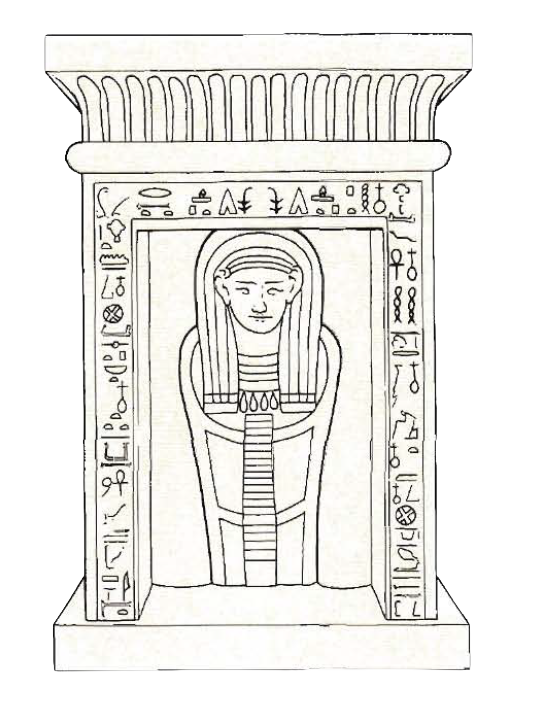
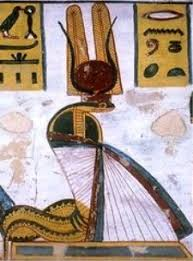
She could be represented as human with a serpent head or as a recoiling serpent on a plinth. However, Renenutet could also be represented in a fully humanoid form, much like her adjacent goddesses. In some contexts, Wadjet and Nekhbet are shown as supplicants to her, and like those Two Ladies, she is represented with the solar horn disk of Hathor and Isis. Much like Wadjet, she is often shown adjacent to Sekhmet, and the fact her temple contains a depiction of fate, Seshat, is not surprising. Most of all, she as associated in Late Egyptian contexts with the deity of fate, Shai. The historian Joyce Tyldesley summarizes the pairing very clearly where she says that Shai determined a person’s lifespan, while Renenutet determined material wealth.³⁵ She specifically connects this to the Late Period Papyrus Insinger tradition. They function as a conceptual pair governing the shape of a human life. The serpent goddess Meretseger was sometimes associated with her.
¹⁹
As she is a syncretized form of Wadjet and Nekhbet who ruled over the two distinct regions of Kemet, she could be represented wearing the dual crown.
As Thermouthis, she is often represented with the sun disk,³⁶ a type of crown associated with Isis. The torch is her most important distinctive symbol, which archeologists have noted. It represents enlightenment in darkness and the cultivation of fire put to good use, the prerequisite of any civilization, but also relates to the serpent and powers of the third eye being sparked. Ears of corn³⁷ and and stalks could be represented in her imagery also, which in Egyptian contexts tends to be represented as Renenutet overseeing agrarian scenes of people gathering the yields of the field. The torch and corn symbolism also shows her association with Demeter and Persephone as a goddess of sustenance and intercession for the dead.

The Major Arcana card of the snake goddess is the Sun, the card of abundance, plenty and with symbolism usually relating to children and nourishment. The child rejoices under the Sun riding a white horse, showing some level of mastery at an early age over his mind. The abundance of the sunflowers sat atop a wall shows the prerogatives of civilization in creating beauty and bountiful rewards for its adherents. The red flag is somewhat snake-like as it coils around the attached spear. The card shows many elements of happiness for the querent, including fertility and the ability to sustain oneself with great rewards. Bune's traditional appearance of being glamorous also shows here.
On a darker note, her Minor Arcana card is the reversed Five of Wands, showing cooperation and the necessity of moving on from conflict. Cooperation is often needed for the querent, or some kind of strategy the snake would be proud of, of course. This can also relate to the advice of the afflicted after disappearing from something violent, something Renenutet on behalf of the dead is said to supervise as the one who allows the dead to speak from the Hall of Judgement. On the other hand, this can also indicate an escalation of aggression and to be wary and careful.
GOETIC SYMBOLISM
The Old Testament in its Greek translation from Hebrew rendered the Pharaoh's daughter as Thermouthis,³⁸ which is an example of confusingly co-opting a divine force for Yehuboric purposes and confusion on the part of this people during the time period. Josephus claims the maiden named Moses his sacred name, which is an obvious occult allusion to the ren. As she is his wetnurse, she is also his provider, and this is linked to the Pharaoh's daughter traditionally being the supplicant of the goddess. The reason for this is the same as above: Moses is placed under the protection of the divine aegis of the snake, which also becomes his symbol.
In the Goetia, she was called Bune or Bim which is related to one of her titles, Buto, but hints too at the name Nekhbet. The demon has three heads as a dragon (serpent), with the third being like a man, a reference to both Thermouthis and the Two Ladies. Bune is said to speak with a divine voice, bestow eloquence and to inspire truth. He is also said to make many devils assemble at graves and to greatly enrich men under his possession. Another entity, Myeob (Queen of the Fairies, simply Bim reversed), is explicitly described in the earlier Liber Officium Spiritum³⁹ a fairy queen who assists her husband Oberon.
Pseudomonarchia daemonum, Johann Weyer⁴⁰
Bune is a great and a strong Duke, he appeareth as a dragon with three heads, the third whereof is like to a man; he speaketh with a divine voice, he maketh the dead to change their place, and divels to assemble upon the sepulchers of the dead: he greatlie inricheth a man, and maketh him eloquent and wise, answering trulie to all demands, and thirtie legions obeie him.
BIBLIOGRAPHY
1. The Complete Gods and Goddesses of Ancient Egypt, Richard H. Wilkinson
2. Renenutet: worship and popular piety at Thebes in the New Kingdom, Paolo Marini Journal of Intercultural and Interdisciplinary Archaeology
3. Utterance 256, Pyramid Texts
4. Utterance 622, Pyramid Texts
5. Utterance 73, Pyramid Texts
6. Coffin Texts
7. EA10470,3, Papyrus of Ani, British Museum
8. Book of the Dead
9. The Role of Renenutet in New Kingdom Temples: A Reassessment of Archaeological Evidence for a Cult of this Divinity in Archaeological Compounds, Julie Masqueller-Loorius, Journal of Intercultural and Interdisciplinary Archaeology
10. Remarks on the Four Renenutets in the Temples of Edfu and Dendara, Frédéric Mougenot
11. Playing with Fire: Initial Observations on the Religious Uses of Clay Cobras from Amarna, Kasia Szpapowska
12. Hymn to Renenutet
13. Sobek of Shedet: The Crocodile God in the Fayyum in the Dynastic Period, Marco Zecchi
14. Handbook of Egyptian Mythology, Geraldine Pinch
15. Grape Archaeology and Ancient DNA Sequencing, Maria Rosa Guasch-Jané, the Grape Genome
16.
stela, EA1055, the British Museum
17. Древнеегипетский праздник Рененутет (The Ancient Egyptian feast of Renenutet), Alexandra Mironova
18. Calendars and Festivals of Ancient Egypt, Alexandra Mironova
19. DO NOT CELEBRATE YOUR FEAST WITHOUT YOUR NEIGHBOURS, A Study of References to Feasts and Festivals in Non-Literary Documents from Ramesside Period Deir el-Medina, Heidi Jauhiainen
20. Ostracon of Deir-el-Medina 1265
21. CHILD DEITIES/اآللھة على ھيئة الطفل, Dagmar Budd, UCLA Encyclopedia of Egyptology
22. EA597 Naos
23. Die Toponyme vorarabischen Ursprungs im modernen Ägypten, Konstanz Carsen Peust
24. Gottesdiener und Kamelzüchter: Das Alltags- und Sozialleben der Sobek-Priester im kaiserzeitlichen Fayum, Benjamin Sippel
25. Medinet Madi, Madain Project
26. Egypt finds clue to ancient temple's secret, Middle East Times (citing Zahi Hawass)
27. The Complete Temples of Ancient Egypt, Richard H. Wilkinson
28. I templi di Medinet Madi nel Fayum, Giammarusti Breschiani
29. Kom Abu Bello, Zahi Hawass, Encyclopedia of the Archaeology of Ancient Egypt, Kathryn A. Bard (eds.)
30. Isis Thermouthis in the Roman World: some Data from the Italian Peninsula, Vito Mazzuca, Journal of Intercultural and Interdisciplinary Archaeology
31. Bracelet with Agathodaimon, Isis-Tyche, Aphrodite, and Thermouthis, the Met, Rogers Fund
32. Greek and Egyptian Hymns to Isis, attalus.org
33. Graeco-Egyptian Interactions: Literature, Translation, and Culture, 500 BC–AD 300
34. The Goddess Thermuthis, Moses, and Artapanus, Amorai-Stark Shua and David Flusser
35 The Handbook of Egyptian Mythology, Joyce Tyldesley
36. On the Endurance of Indigenous Religious Culture in Ptolemaic and Roman Egypt: Evidence of Material Culture, Tiffany Chezum
37.
RPC III, 6184, Roman Coinage Online
38. Antiquities of the Hebrews, Josephus
39. Liber Officium Spiritum
40. Pseudomonarchia daemonum, Johann Weyer


![Arcadia [NG]](/data/avatars/m/2/2320.jpg?1720432497)